The Business of Cinema Is No Longer Built on Creativity Alone
Film Business Expo India is transforming how filmmakers, producers, investors, OTT platforms, distributors, and technology companies connect to build partnerships, secure funding, and explore new business opportunities. As the entertainment industry becomes increasingly collaborative and technology-driven, business-focused film exhibitions have become essential platforms for networking, innovation, and long-term industry growth.
A brilliant script, talented cast, and skilled production team are essential ingredients for making a successful film. However, today’s entertainment landscape demands much more than creative excellence. Financing, distribution, strategic partnerships, technology adoption, and global market access have become equally important in determining whether a project reaches audiences and achieves commercial success.
This shift has transformed the way films are developed, funded, marketed, and distributed. Producers now seek investors who understand the long-term value of entertainment assets. Investors look for scalable projects backed by experienced teams and viable distribution strategies. OTT platforms search for compelling stories that can attract subscribers across diverse markets. Distributors evaluate projects with both theatrical and digital potential, while technology providers continue introducing innovative tools that improve production efficiency.
In this interconnected environment, a Film business expo India serves as more than an industry gathering. It creates a structured business ecosystem where every stakeholder can meet, exchange ideas, evaluate opportunities, and build relationships that may shape future productions.
Instead of relying solely on personal introductions or isolated meetings, professionals increasingly participate in dedicated industry events that bring the complete filmmaking value chain together. These events encourage collaboration, reduce information gaps, and accelerate business development within the media and entertainment sector.
This article explores how film business exhibitions facilitate meaningful partnerships between producers, investors, OTT platforms, studios, distributors, government agencies, and technology companies while contributing to the long-term growth of the film industry.

What Is a Film Business Expo?
Featured Snippet Answer
A film business expo is a professional B2B event where filmmakers, producers, investors, distributors, OTT platforms, studios, technology providers, government organizations, and industry service companies meet to explore partnerships, showcase innovations, discuss industry trends, secure investments, and develop business opportunities across the film and entertainment ecosystem.
Unlike consumer entertainment events focused on celebrity appearances or film promotions, business expos emphasize collaboration, investment, technology, and commercial growth.
Professionals attend these events to:
- Discover financing opportunities
- Meet production partners
- Connect with distributors
- Explore OTT acquisition possibilities
- Evaluate filmmaking technology
- Learn from industry experts
- Build international collaborations
- Expand business networks
These objectives make film business exhibitions valuable for organizations at every stage of the production lifecycle.
Why the Film Industry Depends on Strategic Networking
The film industry operates through relationships. Every successful production involves dozens of organizations working together, often across multiple countries and business disciplines.
Modern Filmmaking Requires Multiple Stakeholders
Today’s projects may involve:
| Stakeholder | Primary Contribution |
|---|---|
| Producers | Project development and management |
| Investors | Financial support |
| Directors | Creative execution |
| Studios | Infrastructure and production resources |
| OTT Platforms | Digital distribution |
| Distributors | Market expansion |
| Technology Providers | Production innovation |
| Government Bodies | Incentives and policy support |
| Film Commissions | Location assistance |
| Marketing Agencies | Audience development |
No single organization can independently manage every aspect of production, financing, marketing, and distribution.
As productions become increasingly complex, networking evolves from an optional activity into a business necessity.
How Producers Connect with Investors
One of the biggest challenges for filmmakers is securing funding at the right stage of development.
Many promising projects fail to move beyond the script stage because producers struggle to identify investors whose goals align with their creative vision and financial expectations.
Professional networking environments help bridge this gap by creating opportunities for structured business discussions rather than informal introductions.
What Investors Typically Evaluate
Before funding a project, investors often consider several factors:
Story Potential
A compelling narrative with clear audience appeal remains one of the strongest indicators of commercial potential.
Production Team
Experienced producers, directors, and department heads reduce execution risk.
Financial Planning
Detailed budgeting, cash-flow projections, and revenue forecasts demonstrate professional project management.
Distribution Strategy
Investors prefer projects with realistic plans for theatrical release, OTT licensing, television rights, international sales, or hybrid distribution.
Market Demand
Current audience preferences, genre trends, and regional demand influence investment decisions.
When producers understand these evaluation criteria, conversations with potential financiers become more productive and focused.
Why Investors Are Increasingly Interested in Entertainment Projects
Entertainment has evolved into a diversified investment sector with multiple revenue channels extending far beyond traditional box office earnings.
Modern projects may generate income through:
- Domestic theatrical releases
- International distribution
- OTT licensing
- Satellite television rights
- Music rights
- Merchandise
- Brand partnerships
- Digital rentals
- Airline entertainment
- Educational licensing
- Franchise development
This diversified revenue model can make carefully selected film projects attractive to investors seeking long-term intellectual property value.
However, investment decisions require access to credible producers, transparent business plans, experienced creative teams, and measurable market opportunities. Business-focused industry events create environments where these factors can be evaluated through direct interaction rather than relying solely on documentation.
How OTT Platforms Discover New Content
The rapid expansion of digital streaming has significantly changed how audiences consume entertainment. As subscriber expectations continue to evolve, OTT platforms require a constant pipeline of fresh, high-quality content across multiple languages, genres, and formats.
This growing demand has increased opportunities for independent filmmakers, regional production houses, documentary creators, and emerging studios.
What OTT Platforms Look For
Streaming platforms typically assess projects based on several business and creative factors.
Original Stories
Audiences increasingly seek distinctive narratives that offer new perspectives rather than repetitive concepts.
Regional Content with Global Appeal
Local stories capable of resonating with international viewers have become highly valuable.
Production Quality
Strong cinematography, sound design, visual effects, and editing improve acquisition potential.
Audience Demand
Data-driven insights help platforms identify genres with strong engagement and long-term viewing potential.
Intellectual Property Value
Projects that can evolve into series, sequels, or broader franchises often receive greater attention due to their scalability.
By understanding these priorities, producers can position their projects more effectively when engaging with digital content buyers.
Why Direct Meetings Matter More Than Digital Outreach
Email pitches and online submissions remain important, but they rarely replace the value of face-to-face business conversations.
In-person interactions allow professionals to:
- Explain creative vision with greater clarity.
- Receive immediate feedback from decision-makers.
- Build trust through personal engagement.
- Discuss commercial expectations in detail.
- Explore partnership models beyond a single project.
- Identify shared long-term business interests.
These conversations often lead to follow-up meetings, collaborative development, and stronger professional relationships that extend beyond a single production.
How Distributors Identify Promising Film Projects
Completing a film is only one part of the journey. Reaching the right audience through effective distribution is equally important. Whether a project is intended for theatrical release, streaming platforms, television, or international markets, distributors play a crucial role in maximizing its commercial potential.
For many producers, finding the right distribution partner is one of the biggest challenges after production. Film business events create an environment where distributors can evaluate multiple projects, meet production teams, and discuss release strategies before a film enters the market.
What Distributors Look For
Distributors assess projects using both creative and commercial criteria.
Audience Appeal
A film should have a clearly defined target audience. Understanding who the film is for helps distributors determine suitable release strategies and marketing campaigns.
Marketability
Strong promotional potential, recognizable talent, compelling trailers, and unique selling points make a project easier to position in a competitive marketplace.
Genre Performance
Certain genres consistently perform well in specific regions or on digital platforms. Distributors analyze historical trends alongside current audience preferences before making acquisition decisions.
Distribution Rights
Clear ownership of theatrical, digital, satellite, international, and ancillary rights simplifies negotiations and reduces legal complexities.
Release Timing
The timing of a release can significantly influence box office performance or streaming visibility. Seasonal trends, competing releases, and audience behavior all factor into distribution planning.
When producers and distributors engage early in the project lifecycle, they can align creative decisions with market realities, improving the likelihood of commercial success.
The Growing Importance of Co-Production Partnerships
As filmmaking becomes more global, co-productions have emerged as a practical way to share resources, reduce financial risk, and access new markets.
A co-production involves two or more production companies, often from different countries, collaborating on the development, financing, and production of a film or series.
Benefits of Co-Productions
- Shared production costs
- Access to international funding
- Broader distribution opportunities
- Diverse creative expertise
- Eligibility for government incentives
- Access to new filming locations
- Increased global audience reach
These partnerships are particularly valuable for independent filmmakers and mid-sized production houses seeking to expand beyond domestic markets.
Example Workflow for a Co-Production
- Develop a marketable concept.
- Identify compatible production partners.
- Finalize financial contributions.
- Secure legal agreements.
- Apply for applicable incentives and grants.
- Execute production collaboratively.
- Plan domestic and international distribution.
Business networking platforms often facilitate these introductions by bringing together producers, studios, investors, and international delegates under one roof.
How Government Film Bodies Support Industry Growth
Government agencies and film commissions play an increasingly important role in encouraging domestic and international productions.
Their support extends beyond policy-making and often includes practical assistance throughout the production process.
Common Areas of Support
Production Incentives
Many regions offer financial incentives such as rebates, tax benefits, or grants to attract film productions.
Location Assistance
Film commissions help production teams identify suitable shooting locations while coordinating local permissions and logistics.
Single-Window Clearances
Simplified approval systems reduce administrative delays and make productions more efficient.
Infrastructure Development
Governments continue investing in studios, training centers, and creative industry hubs to strengthen their regional film ecosystems.
International Promotion
Many film commissions actively promote their regions as attractive filming destinations through trade missions, exhibitions, and global partnerships.
For producers considering international projects, direct interaction with government representatives can significantly simplify planning and execution.
Technology Is Transforming the Business of Filmmaking
Technology has become one of the strongest drivers of change across every stage of the filmmaking process.
Today’s productions increasingly rely on digital tools that improve efficiency, reduce costs, and enhance creative possibilities.
Key Technologies Reshaping the Industry
Artificial Intelligence
AI-powered solutions assist with script analysis, scheduling, subtitle generation, localization, editing support, audience analytics, and content recommendations.
Virtual Production
LED volumes and real-time rendering technologies reduce dependence on physical locations while offering greater creative flexibility.
Cloud Collaboration
Production teams across different countries can now collaborate seamlessly on editing, sound design, visual effects, and production management.
Advanced Post-Production
Modern editing software, color grading systems, CGI, motion capture, and visual effects continue raising production standards across independent and large-scale projects alike.
Data Analytics
Studios, distributors, and OTT platforms increasingly rely on audience insights and viewing behavior to guide investment and content acquisition decisions.
Technology providers benefit from demonstrating these innovations directly to filmmakers and production companies, allowing professionals to evaluate practical applications before making investment decisions.
Challenges That Continue to Affect Film Business Collaboration
Despite growing opportunities, several challenges remain within the global entertainment industry.
Limited Access to Decision Makers
Many independent filmmakers struggle to reach investors, distributors, or commissioning executives through conventional channels.
Financing Gaps
Creative projects often fail to secure funding despite strong artistic potential due to limited investor access or insufficient business planning.
Rapid Technological Change
Keeping pace with evolving production technologies requires continuous learning and investment.
International Market Complexity
Cross-border productions involve legal, financial, tax, and cultural considerations that require specialized expertise.
Intense Competition
Thousands of films compete annually for limited distribution windows, streaming acquisitions, and audience attention.
Understanding these challenges helps industry professionals prepare more effectively and identify opportunities for differentiation.
Best Practices for Building Meaningful Industry Relationships
Networking is most effective when approached strategically rather than casually.
Before Attending an Industry Event
- Define clear business objectives.
- Research participating companies.
- Prepare concise project presentations.
- Update your production portfolio.
- Schedule meetings in advance.
- Identify potential collaborators based on your goals.
During the Event
- Focus on quality conversations rather than collecting business cards.
- Listen carefully to business needs.
- Ask thoughtful questions.
- Share practical insights rather than making sales pitches.
- Follow professional etiquette during meetings.
After the Event
- Send personalized follow-up messages.
- Share requested materials promptly.
- Continue conversations through scheduled meetings.
- Explore collaboration opportunities beyond immediate projects.
- Maintain long-term professional relationships.
Consistent follow-up often determines whether an initial introduction develops into a successful partnership.
Decision Framework: Choosing the Right Film Business Event
Not every industry event serves the same purpose. Selecting the right platform depends on your professional objectives.
| Goal | Best Type of Industry Event |
|---|---|
| Raise production funding | Investor-focused film market |
| Find OTT buyers | Content marketplace |
| Secure distribution | Film market and distribution summit |
| Discover filmmaking technology | Film technology exhibition |
| Build production partnerships | International film business expo |
| Learn industry trends | Conferences and panel discussions |
| Explore government incentives | Film commission showcases |
| Expand international reach | Global B2B entertainment exhibition |
Evaluating an event based on its audience, exhibitors, educational sessions, and networking opportunities ensures better returns on your time and investment.
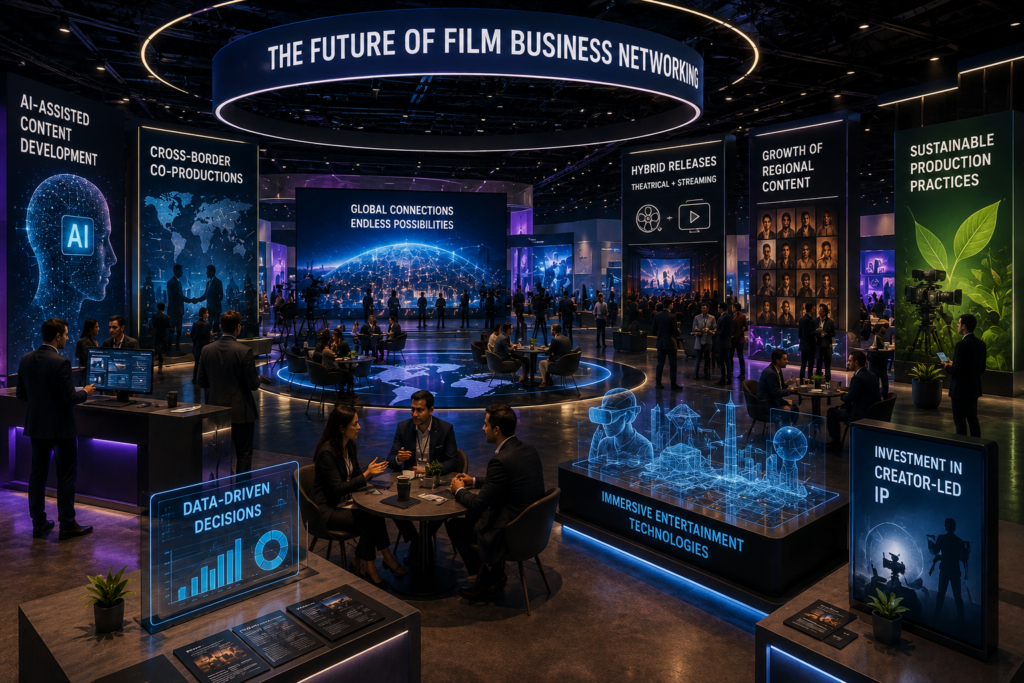
The Future of Film Business Networking
The entertainment industry is becoming increasingly collaborative, data-driven, and globally connected.
Several trends are expected to shape future business interactions:
- AI-assisted content development
- Cross-border co-productions
- Hybrid theatrical and streaming releases
- Growth of regional language content
- Virtual networking alongside physical exhibitions
- Sustainable production practices
- Increased investment in creator-led intellectual property
- Expansion of immersive entertainment technologies
Professionals who actively engage with these developments are better positioned to adapt to changing audience preferences and emerging business models.
Conclusion
The success of modern filmmaking depends on much more than creative talent. Sustainable growth requires access to financing, reliable distribution channels, strategic partnerships, advanced production technologies, and strong professional networks. Producers, investors, OTT platforms, distributors, technology providers, government film bodies, and service companies each contribute to a connected ecosystem where collaboration drives innovation and commercial success.
As the global entertainment landscape continues to evolve, industry professionals benefit from participating in platforms that bring together the entire value chain in one place. One such example is Film Expo India, a large-scale international film and media industry exhibition and B2B marketplace scheduled from 26–30 August 2026 at Bharat Mandapam, New Delhi. Curated by Exhobuzz Pvt Ltd, it brings together filmmakers, producers, studios, OTT platforms, distributors, investors, technology providers, exhibitors, government film bodies, film commissions, and global entertainment professionals. Through exhibitions, live demonstrations, conferences, networking sessions, pitching opportunities, technology showcases, and initiatives such as “Shoot in India,” the platform reflects many of the collaborative principles discussed throughout this article. Rather than focusing on a single segment of the industry, it creates an environment where knowledge sharing, investment opportunities, business partnerships, technology discovery, and long-term film business growth can naturally take place.