For many filmmakers, getting a project made is only half the challenge. Finding the right producer, equipment partner, distributor, investor, technology provider, post-production team, or co-production contact can be equally difficult. Talent and a strong script matter, but the modern film business also depends on relationships, access to information, and the ability to identify the right commercial opportunities.
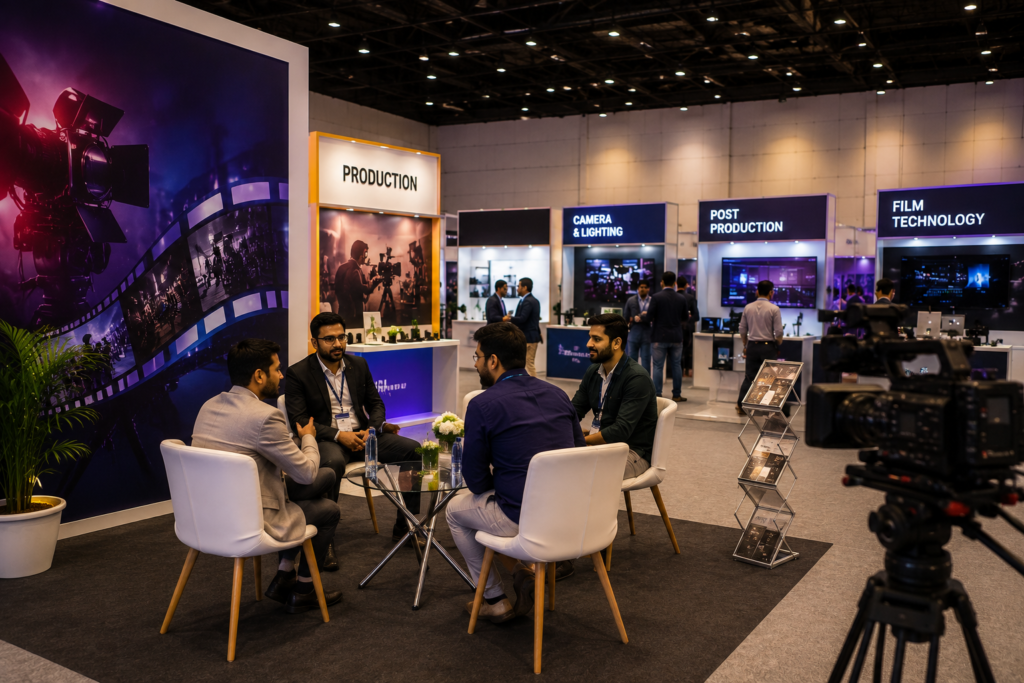
This is where film industry networking becomes valuable. Industry exhibitions, film markets, conferences, and professional gatherings bring different parts of the filmmaking ecosystem into the same physical environment. Film Expo India 2026 is one such platform where filmmakers can explore several parts of the filmmaking value chain in one place.
Global audiovisual markets demonstrate this model. The Producers Network at the Marché du Film, for example, is specifically designed to help producers expand professional networks and discover co-production opportunities. Similarly, MIA in Rome operates as an international business and networking platform connecting producers, distributors, buyers, streamers, investors, institutions, and creative professionals.

What Is Film Industry Networking?
Film industry networking is the process of building professional relationships with people and organizations involved in filmmaking, production, distribution, technology, financing, exhibition, and entertainment.
It can involve:
- Meeting producers and production houses
- Connecting with directors, writers, actors, and cinematographers
- Finding distributors and sales partners
- Discovering film production equipment
- Exploring post-production, VFX, and animation services
- Meeting investors and financing professionals
- Identifying co-production opportunities
- Learning about OTT and digital distribution
- Connecting with film commissions and government bodies
- Building long-term professional relationships
Effective networking is not simply collecting business cards. The real objective is to find relationships that can lead to collaboration, knowledge exchange, referrals, investment, employment, or future projects.
10 Benefits of Visiting a Film Expo for Filmmakers
1. Build a Stronger Professional Network
The first major benefit is direct access to people across the filmmaking ecosystem.
A filmmaker may need a producer today, a cinematography partner tomorrow, and a distributor several months later. Professional industry gatherings can shorten the distance between these requirements and potential solutions.
Instead of approaching every company individually, filmmakers can have multiple conversations within a limited period.
A useful networking strategy is to identify three categories before attending:
- People you need to meet
- Companies whose services interest you
- Professionals whose knowledge you want to learn from
This makes networking more purposeful than simply trying to meet as many people as possible.
2. Discover Film Production Technology
Technology is changing almost every stage of filmmaking.
Modern production environments increasingly involve digital cameras, virtual production, AI-assisted workflows, cloud collaboration, advanced editing, motion capture, VFX, animation, digital sound, and automated production tools. Research into AI and creative industries also highlights its growing role in content creation and post-production workflows, while emphasizing the continuing importance of human oversight.
For filmmakers, seeing technology demonstrated in person can be more useful than simply reading about it online.
A technology showcase can help answer practical questions such as:
- Can this tool reduce production time?
- Is it suitable for independent filmmaking?
- What is the learning curve?
- Can it integrate with an existing workflow?
- What are the long-term operating costs?
Technology discovery can therefore influence both creative decisions and production budgets.
3. Find Production and Post-Production Partners
Filmmaking involves hundreds of specialized tasks.
A project may require:
- Camera and lighting services
- Sound recording
- Studio facilities
- Editing
- Colour grading
- VFX
- Animation
- Dubbing
- Subtitling
- Music production
- Digital marketing
- Distribution support
Meeting service providers directly allows filmmakers to compare capabilities rather than relying entirely on online searches.
This is especially useful for independent filmmakers and smaller production companies that may not have large internal teams.
4. Explore Film Financing and Investment Opportunities
Financing is one of the biggest barriers between a film concept and production.
Networking with investors, producers, financiers, distributors, and business representatives can help filmmakers understand how projects are evaluated commercially.
However, filmmakers should not approach networking as a simple funding request.
A better approach is to prepare:
- A concise project synopsis
- Budget range
- Target audience
- Current development stage
- Production timeline
- Distribution strategy
- Revenue or commercial assumptions
- Team credentials
A strong project conversation connects creative potential with a credible business model.
International film markets increasingly combine financing, co-production, distribution, and networking. MIA, for instance, describes its platform around these interconnected activities rather than treating them as separate functions.
5. Discover Distribution and OTT Opportunities
Completing a film does not guarantee that audiences will find it.
Distribution has become increasingly complex across theatrical releases, television, streaming platforms, digital rentals, international sales, and regional markets.
Industry events can help filmmakers understand how distributors and content buyers assess projects.
Questions worth asking include:
- Which genres are currently attracting buyers?
- What territories does a distributor cover?
- Does the company handle theatrical or digital distribution?
- What rights does it acquire?
- Does it work with independent filmmakers?
- What marketing support does it provide?
These conversations can improve a filmmaker’s understanding of the commercial side of cinema.
6. Identify Co-Production Opportunities
Co-production can help projects access additional financing, talent, locations, production infrastructure, and international markets.
Government-backed film resources also increasingly support international producers with information about locations, filming permissions, production resources, and co-production opportunities. India’s India Cine Hub, for example, provides directories covering filming locations, production resources, co-producers, permissions, and incentives.
For filmmakers interested in international projects, networking can therefore become the first step toward discovering suitable partners.
A successful co-production discussion should clarify:
Creative fit + financial contribution + production responsibilities + rights + distribution territory.
7. Learn From Industry Experts
Networking is not limited to business deals.
Panels, conferences, workshops, demonstrations, and expert discussions can expose filmmakers to practical knowledge that is difficult to obtain from textbooks.
Topics may include:
- Film financing
- Production management
- Screenwriting
- OTT distribution
- VFX
- AI in filmmaking
- Virtual production
- International co-production
- Marketing
- Film festivals
- Intellectual property
This knowledge can help filmmakers avoid expensive mistakes.
For example, learning about post-production requirements before shooting begins can influence decisions about camera formats, data management, visual effects, sound recording, and production schedules.
8. Stay Ahead of Emerging Film Industry Trends
The filmmaking business is evolving quickly.
AI-assisted production, virtual production, real-time rendering, cloud workflows, streaming distribution, immersive media, and new content formats are changing how projects are developed and delivered.
Recent research describes generative AI as capable of reshaping professional roles and production workflows while also creating questions around authorship, ethics, and creative control.
For filmmakers, the important question is not simply “What is the newest technology?”
It is:
Which emerging technology can create a meaningful advantage for my project?
Industry exhibitions provide an opportunity to compare technologies, speak with specialists, and evaluate whether a trend is commercially useful or simply temporary hype.
9. Improve Your Understanding of the Film Business
Creative professionals often focus heavily on storytelling while having limited exposure to the commercial infrastructure surrounding cinema.
A professional industry event can reveal how different participants connect:
Idea → Development → Financing → Production → Post-Production → Distribution → Marketing → Audience
Understanding this complete workflow helps filmmakers make better decisions.
For example, a director who understands distribution requirements may approach production differently. A producer familiar with technology costs may create more realistic budgets. A writer who understands current content demand may develop projects with clearer market positioning.
This is one of the most valuable forms of film business networking because the knowledge gained can influence future projects.
10. Create Long-Term Career Opportunities
The most valuable networking result may not happen during the event itself.
A conversation today can become:
- A freelance assignment next month
- A production partnership next year
- A financing relationship later
- A recommendation for another project
- A co-production opportunity
- A long-term technology partnership
This is why effective networking should be treated as relationship building rather than immediate selling.
Why Film Industry Networking Is Becoming More Important
The modern film ecosystem is no longer divided neatly between filmmakers, studios, broadcasters, distributors, and technology companies.
Streaming has changed distribution. AI is influencing creative and technical workflows. International co-production is creating new financing possibilities. Film commissions are promoting locations and production infrastructure. Technology companies are becoming increasingly important participants in content creation.
That means filmmakers need broader industry awareness.
Professional markets and trade platforms reflect this convergence by bringing financing, production, distribution, technology, and creative talent into connected environments.
The result is a film industry where relationships increasingly cross traditional categories.
Frequently Asked Questions
1. Why is film industry networking important for filmmakers?
Film industry networking helps filmmakers discover collaborators, producers, distributors, investors, technology providers, production services, and career opportunities. It can also provide industry knowledge that supports better business and creative decisions.
2. What should filmmakers take to a film industry event?
Filmmakers should carry a concise portfolio, updated showreel, project synopsis, contact details, professional biography, and basic information about budget, genre, audience, and project stage.
3. Can film expos help independent filmmakers?
Yes. Independent filmmakers can use professional industry events to find affordable production services, technology providers, collaborators, investors, distributors, and educational opportunities that may otherwise be difficult to access individually.
4. How do filmmakers find investors for films?
Filmmakers can meet potential investors through producers, film markets, financing forums, industry networks, pitch programs, and professional events. A clear project proposal, realistic budget, audience strategy, team credentials, and financing structure are important.
5. What is a co-production opportunity in filmmaking?
A co-production is a project developed or financed by two or more production partners, often from different companies or countries. It can provide access to financing, talent, locations, production resources, and distribution networks.
6. How can filmmakers use AI in film production?
AI can assist with areas such as ideation, pre-production, editing, visual development, post-production, and workflow automation. However, filmmakers should evaluate tools based on creative control, accuracy, rights, ethics, and production requirements.
7. Is networking useful for film students?
Yes. Film students can use networking to meet working professionals, discover career paths, learn about production technologies, find mentors, and understand the commercial side of the entertainment industry.
8. How should filmmakers follow up after networking?
A good follow-up should be personalized and reference the original conversation. Instead of sending a generic promotional message, explain why you are reconnecting and provide any information or material that is relevant to the discussion.
Conclusion
Filmmaking is ultimately a collaborative business. A strong idea may begin with a writer or director, but turning that idea into a finished and commercially viable project can require producers, investors, studios, technology companies, post-production specialists, distributors, government bodies, and many other professionals.
That is why film industry networking deserves to be treated as part of a filmmaker’s professional strategy rather than an optional social activity. The right industry connection can lead to knowledge, technology, financing, collaboration, distribution, or an entirely new career opportunity.
For professionals looking to experience this ecosystem in one place, Film Expo India is a large-scale international film and media industry exhibition and B2B marketplace scheduled for 26–30 August 2026 at Bharat Mandapam, New Delhi. Its stated focus brings together filmmakers, producers, studios, OTT platforms, distributors, investors, technology providers, exhibitors, government film bodies, and global entertainment professionals. The platform is designed around networking, business collaborations, knowledge sharing, technology discovery, investment opportunities, and industry partnerships.
Its wider ecosystem, including areas such as film technology, post-production, production services, distribution, financing, and initiatives promoting India as a filming destination, reflects the growing connection between creativity and commerce. For filmmakers, the larger lesson is simple: staying connected to the people, technologies, and business models shaping cinema can be just as important as mastering the craft itself. Register as a Visitor :